You finished 100 lessons on AI. Here is what to do next.
Today, AI Align published its 100th post.
When this series started in April 2026, the goal was simple: explain AI from the beginning, one idea at a time, for free. No jargon. No assumed knowledge. No hype. Just the things that are actually useful, explained the way a calm, experienced person would explain them to someone they respect.
One hundred posts later, if you have been following along, you know what AI is and what it is not. You know how it works and where it gets things wrong. You know how to use it for your exams, your work, your business, your home. You know how to stay safe and how to recognise the myths that still circulate in family groups and news headlines.
100 posts. One idea at a time.
What AI is. How it works. Eight tools. Mistakes, privacy, jobs, creativity, bias. Kids, parents, family safety, scams. Exams, placements, small business, languages. Myths, companies, creators, government services. Students, professionals, teachers, business owners, homemakers.
The foundation is complete. What comes next is up to you.
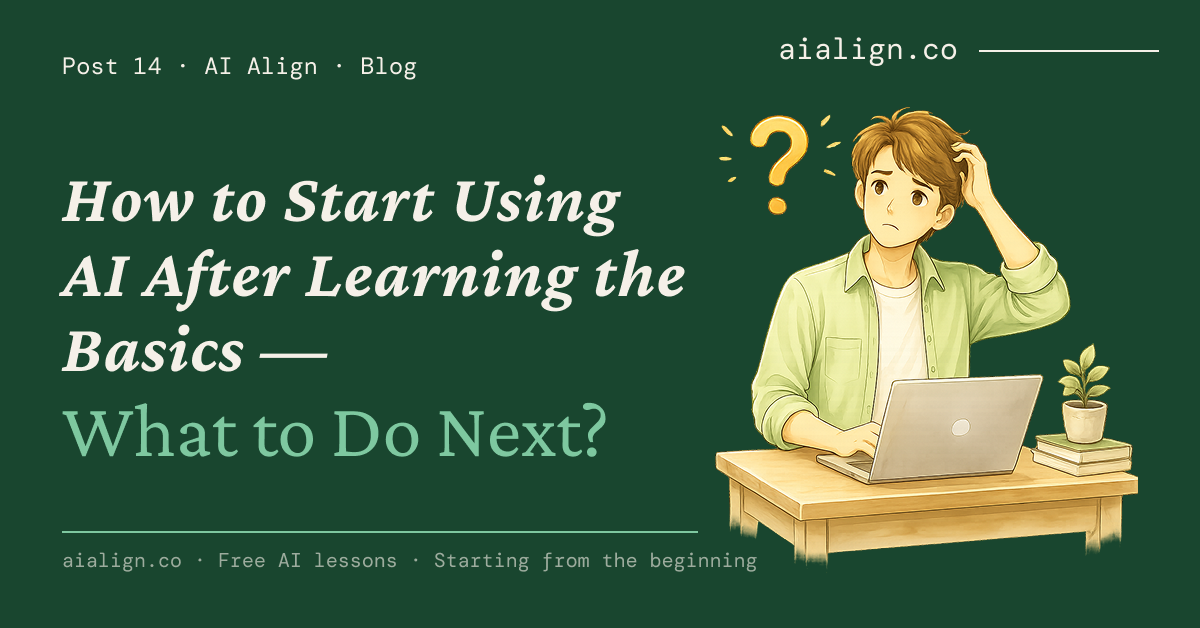
But here is what I have noticed, running this series for the past hundred days: there is a gap between understanding something and actually doing it. And that gap is where most people stay.
This post is about closing it.
Why knowing is not enough.
Reading about AI, watching videos about AI, following an account that explains AI — none of these make you someone who uses AI. They make you someone who knows about AI. That is genuinely useful. But it is not the same thing.
The person who knows about AI but does not use it is in the same position as someone who reads about swimming but never gets in the water. The knowledge is real. The skill is not yet there.
The skill comes from doing. Specifically, from doing something real — not a test, not a demonstration, not “let me see what this thing can do.” A genuine task. Something you actually needed done. Something where the output either helped you or it did not, and you learned something either way.
The framework. Four steps.
Pick one real task from your day.
Not “what is the capital of France.” Something you actually need. An email you have been putting off. A topic you want to understand better. A decision you are turning over in your head. A document you need to summarise before a meeting. The more real the task, the more useful the result — and the more you learn about whether AI is actually helpful for you.
Describe it in plain language.
Open any free AI tool. Type what you need the same way you would explain it to a capable colleague. No special phrases, no commands, no prompting techniques. Just describe the situation and what you want. “I need to reply to a client who is unhappy about a delay. The delay was not our fault but I want to keep the relationship. Help me write something that is honest and professional.” That is enough.
Read critically. Edit. Use it or discard it.
AI will give you something. Read it carefully. Is it right? Is anything missing or wrong? Does it match your situation specifically — or is it generic in a way that would not work? Edit it. Add what AI did not know. Remove what does not fit. Then send it, use it, or discard it and try again with a better description. This critical reading is the actual skill you are building. It develops fast.
Do this once a day for seven days.
One real task. Ten minutes. Seven days. By day three the initial awkwardness is gone. By day five you are describing your tasks more clearly without thinking about it. By day seven it feels like a normal part of how you work — the same way searching on Google became normal, the same way UPI became normal. You will not remember not using it.
The one thing that makes people stop.
There is one reason most people quit before day seven. They start with test questions instead of real tasks.
“What year was the Taj Mahal built?” “Give me a fun fact about penguins.” “Write me a poem about rain.”
These tell you almost nothing about whether AI will be useful for your actual life. The result is either impressive in a party-trick way or obviously not what you needed — and either way you close the tab and do not go back.
Start with something you genuinely needed done today. Not something designed to test AI. Something you would have spent time on anyway — an email, a summary, a decision, a question you have been meaning to look up. That is the task. That is where the habit starts.
What comes after the habit.
Once using AI daily feels normal, the next questions answer themselves through practice: which tasks benefit most, where AI consistently gets things wrong for your specific situation, how to describe what you need more precisely, which tool works better for which kind of work.
These are not things you learn by reading about them. They are things you discover by doing. Every person’s AI habit looks slightly different because every person’s work and life is slightly different. The framework gets you to the point where you can discover yours.
The best teachers in India have always used the best tools available to them. Textbooks, chalk, projectors, YouTube videos for demonstrations, WhatsApp groups for parent communication. AI is the next tool in that list. It handles preparation faster. The teaching remains entirely theirs.
Join AiAlign WhatsApp Channel
Teach one person.
One last thing — and this one is optional but worth doing.
Think about one person in your life who would benefit from understanding AI but has not started yet. A parent who is worried about scams. A student who is anxious about exams. A colleague who keeps saying “I should look into this.” A friend who runs a small business alone.
Do not send them an article. Sit with them for five minutes. Open an AI tool together. Let them type their first question — something they actually want to know. Read the answer together. Talk about what is right and what to verify.
Five minutes of doing together is worth fifty posts of reading alone. AI Align started because nobody was explaining this from the beginning. You can be that person for someone else now. That is how it spreads — not through algorithms, but through one person showing another.
One hundred posts. Thank you for being here for them.
Five minutes of experimenting with AI on a real task tells a teacher more about whether it is useful for them than any article about AI in education — including this one.
New to AI and not sure where to begin? Start with our free guide — 100 posts, one idea at a time, zero jargon.