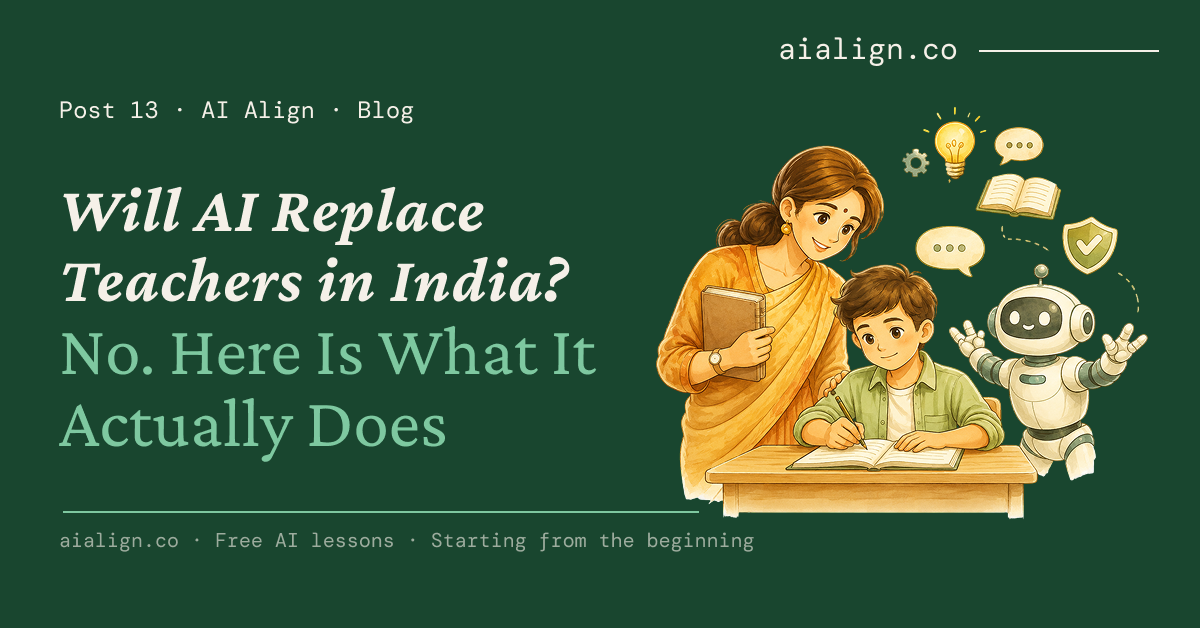
Will AI replace teachers? No. Here is what it actually does.
Where the question comes from.
Every teacher in India has heard some version of this by now. At a staff meeting. From a concerned parent. In a news headline. “AI is going to change education. What does that mean for teachers?”
The question is genuine. The anxiety behind it is real. And the answer is not what the headlines suggest.
AI will not replace teachers. But it will change what teaching looks like — and that change is worth understanding clearly, because teachers who understand it will use it well. Teachers who do not understand it will either ignore it or fear it, neither of which helps the students in front of them.
What AI can actually do for a teacher.
The most useful way to think about AI in teaching is this: it handles preparation. Everything that happens before the class begins — and after it ends — is where AI is genuinely useful.
Lesson planning. Writing a lesson plan that includes an opening activity, three key teaching points, and a closing assessment takes time. AI can produce a strong first draft in under two minutes.
“Create a lesson plan for Class 9 students on photosynthesis. Include a 5-minute opening activity that connects to something in their daily life, three main teaching points, and a five-question quiz at the end.”
Explaining difficult concepts multiple ways. When a concept is not landing for a particular class, the challenge is finding a different angle — a new analogy, a different example, a simpler entry point. AI can generate several alternatives in seconds.
“Explain the concept of osmosis in three different ways: one simple analogy a Class 8 student would understand, one real-world example from everyday life in India, and one comparison to something they already know well.”
Generating question banks. Writing 20 good multiple choice questions with correct answers and explanations for each takes the better part of an afternoon. AI does it in minutes — giving the teacher time to review, improve, and use them.
“Write 20 multiple choice questions on the French Revolution for Class 10 at CBSE standard difficulty. For each question, include the correct answer and a one-line explanation of why it is correct.”
Keeping up with the subject. Teachers are learners too. When a new development in a field is relevant to what they teach, AI can summarise it quickly in plain language — giving the teacher enough context to bring it into the classroom without spending an evening on it.
What AI cannot do.
This is the part that matters most — and the part that gets left out of most conversations about AI and education.
AI cannot notice the student at the back of the room who understood something for the first time today and needs encouragement before that understanding fades.
AI cannot read the silence that means a concept has not landed for this particular group on this particular day and adjust mid-lesson.
AI cannot build the trust that makes a student raise their hand to ask a question they were afraid to ask anywhere else.
AI cannot see that one student’s distracted behaviour today is not laziness — it is something happening at home that needs a quiet conversation after class.
These are not small things. These are the things that determine whether a student learns — not just in that subject, but whether they believe they are capable of learning at all. That belief is built by teachers. It cannot be built by a tool.
Join AiAlign WhatsApp Channel
The right way to think about this.
A teacher who uses AI for lesson planning, question generation, and concept explanation does not become a lesser teacher. They become a teacher with more time — more time for the student who needs an extra explanation, more time for the conversation that matters, more time for the human work that AI was never going to do anyway.
The best teachers in India have always used the best tools available to them. Textbooks, chalk, projectors, YouTube videos for demonstrations, WhatsApp groups for parent communication. AI is the next tool in that list. It handles preparation faster. The teaching remains entirely theirs.
For teachers who want to start.
The starting point does not need to be complicated. Pick the preparation task that takes the most time in a given week — writing questions, planning lessons, drafting parent communication. Try asking AI to do a first draft of that one thing. Read it. Improve it. Use it or discard it.
Five minutes of experimenting with AI on a real task tells a teacher more about whether it is useful for them than any article about AI in education — including this one.
New to AI and not sure where to begin? Start with our free guide — 100 posts, one idea at a time, zero jargon.