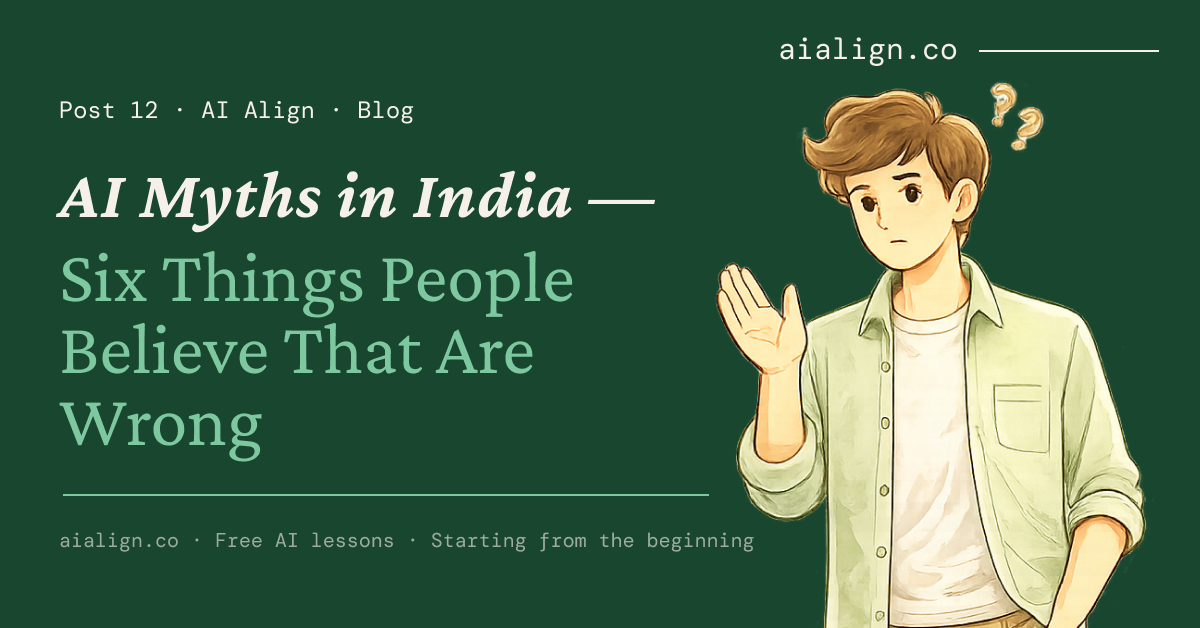
Six things people in India believe about AI. All of them are wrong.
Where these myths come from.
Someone forwarded a message about AI hacking bank accounts. A news headline said AI is watching you. A film showed AI as a surveillance system that knows everything. A relative said using AI is cheating.
None of these are accurate descriptions of how AI tools actually work. But they are common enough that millions of people in India have absorbed them as facts — and those beliefs are now the main reason people who could benefit from AI are choosing not to start.
Here are six of the most persistent ones, and the truth behind each.
The six myths.
Myth 01
"AI is watching me through my camera."
What is actually true: AI tools like the ones you use for text, questions, and writing are software that processes what you type or say. They do not access your camera or microphone unless you specifically grant that permission — the same way any other app on your phone works. If you have not given an app camera permission, it cannot see you. AI is no different.
Myth 02
"AI is only for people who know coding."
What is actually true: The interface for most AI tools is a conversation. You type what you want in plain sentences — the same way you would send a WhatsApp message — and the tool responds. There is no code involved. No technical background required. The entire point of modern AI tools is that they removed the technical barrier that existed before them.
Myth 03
"AI will steal my bank details if I use it."
What is actually true: AI tools do not have access to your bank account. They cannot initiate transactions, view your balance, or access anything you have not typed into them. The sensible rule — do not type your account number, UPI PIN, or Aadhaar number into any AI tool — is the same rule that applies to any website or app. That is good digital hygiene, not an AI-specific risk.
Myth 04
"AI is always right. Whatever it says must be true."
What is actually true: AI is wrong regularly. It invents facts that sound convincing, misquotes sources, gets dates and names wrong, and produces confident answers that are completely fabricated. This is called hallucination — AI predicts what words should come next, and sometimes those predictions are plausible-sounding nonsense. The rule is simple: any fact that matters, verify it with one quick search before you use it. We covered this in detail in Blog Post 7.
Myth 05
"Using AI is cheating."
What is actually true: A calculator did not make maths cheating. Google did not make research cheating. Spell-check did not make writing cheating. AI is a tool — and like every tool before it, what matters is how you use it. Using AI to understand something faster, draft something you then refine, or check your own work is not cheating. Submitting AI output as entirely your own without adding any understanding or judgment is a different question — one that schools and workplaces are actively working through. But using AI as part of your process is no more cheating than using a dictionary.
Myth 06
"AI is too complicated for someone like me."
What is actually true: If you can send a WhatsApp message, you can use AI. The interface is a text conversation. You describe what you need. The tool responds. That is the entire interaction. The people who find AI complicated are usually trying to learn it by reading about it rather than by opening the tool and typing something.
The myth that matters most.
Of all six myths above, the most costly is the last one — “this is not for someone like me.”
The other five are factual errors that are easy to correct. This one is an identity belief. And identity beliefs are the hardest to change, because they do not feel like beliefs. They feel like facts about yourself.
They are not. AI is available to anyone with a smartphone and an internet connection. The learning curve is genuinely shallow. The first useful result usually arrives within the first five minutes of trying.
Join AiAlign WhatsApp Channel
What to do with this.
If you have been holding back because of one of these myths, the most useful thing you can do right now is open any free AI tool and type one genuine question — something you actually want to know, not a test question. See what comes back. Verify the facts if they matter. Read the response with the knowledge that AI can be wrong.
That first real interaction is more informative than any article about AI, including this one.
Ninety posts into this series, there are people who follow every post and have still not opened an AI tool. The myth holding them back is almost always number six. The tool is not complicated. Starting is.
New to AI? Start with our free guide — zero jargon, zero assumed knowledge.