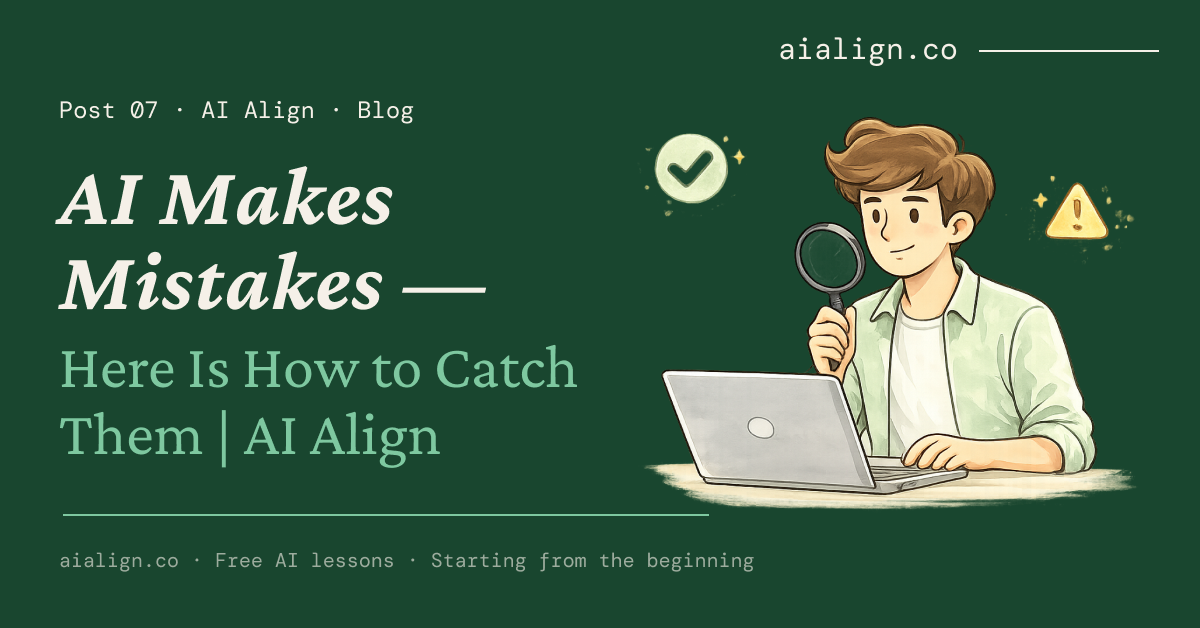
AI makes mistakes. Here is how to catch them.
TL;DR: AI invents book titles, statistics, and facts that sound completely real. This is called hallucination. AI does not know it is wrong — it gives every answer with the same confidence. The fix is simple: any fact AI gives you, Google it once. Three seconds. That is the difference between using AI well and using it dangerously.
A student submitted an essay with a source that does not exist.
The essay was well-written. The arguments were structured. It cited three academic sources. The professor checked the references — two were real. The third was a book that has never been published, by an author who has never written on that topic.
AI made it up. It invented a book title, an author name, and a publication year — and it wrote the citation in perfect academic format. The student submitted it without checking because the citation looked legitimate.
This happens more often than you think. And it has a name.
What is hallucination?
AI does not “know” things the way you do. It does not have a library of verified facts sitting in its memory. It predicts what words should come next — based on patterns from billions of books, websites, and conversations fed to it by the engineers who built it.
Most of the time, those predictions produce useful, accurate answers. But sometimes the patterns create something that sounds right but is completely made up. A book title that was never published. A statistic that was never researched. A historical date that is slightly wrong. A quote attributed to someone who never said it.
This is called hallucination — and the most dangerous part is that AI does not know it is doing it. It does not pause and say “I am guessing here.” It delivers the wrong answer with the exact same confidence as the right one.
Where does AI get it wrong most often?
Names and dates — especially in Indian history and regional context, where the training data is thinner. AI mixes up people, confuses timelines, and combines events that happened decades apart.
Statistics and numbers — AI invents percentages, population figures, and research findings that sound plausible but have no source. If someone quotes an AI-generated statistic in a presentation, the number might not exist anywhere outside that AI conversation.
Sources and references — book titles, journal articles, and author names that AI fabricates in perfect citation format. This is the one that catches students and professionals most often.
Recent events — AI tools have knowledge cutoffs. They do not always know what happened last week. When asked about something recent, they often fill the gap with something plausible rather than saying “I do not know.”
Join AiAlign WhatsApp Channel
The three-second check.
The fix is not complicated. You do not need a fact-checking course or a verification tool. You need one habit.
Any fact AI gives you — Google it once.
Did that book actually get published? Search the title. Does that statistic appear on a real website? Search the number. Is that person actually the one who said that quote? Search the quote.
Three seconds. One search. That is all it takes. If the fact does not appear anywhere outside your AI conversation — it probably does not exist.
This is especially important for anything you are going to submit, publish, present, or send to someone else. An email with a wrong fact is embarrassing. A college assignment with a fabricated source is a serious problem. A business proposal with invented numbers can cost you a client.
Trust AI to help you start. Never trust it to be right.
This is not a reason to stop using AI. It is a reason to use it properly. AI is an extraordinary starting point — for writing, for research, for learning, for getting things done. That has not changed.
What changes is how you treat the output. Read what AI gives you. Check the facts that matter. Verify anything you are going to use publicly. The three-second check is not paranoia — it is the skill that separates someone who uses AI well from someone who uses it dangerously.
AI is confident even when it is wrong. That is the part nobody warns you about. Your job is not to be smarter than AI. Your job is to check what it tells you before you act on it.
AI gets smarter every year. But the judgment — the ability to verify, to question, to decide what is true — that is still yours. And it always will be.
New to AI? Start with our free guide — zero jargon, zero assumed knowledge.
Frequently Asked Questions.
Does AI make mistakes?
Yes. AI makes mistakes regularly, including inventing facts, statistics, book titles, and sources that do not exist. This is called hallucination. AI does not know it is wrong — it delivers incorrect answers with the same confidence as correct ones.
What is AI hallucination?
AI hallucination is when an AI tool generates information that sounds accurate but is completely fabricated. This includes fake book citations, invented statistics, wrong dates, and made-up quotes. It happens because AI predicts words based on patterns, not verified facts.
How do I check if AI gave me the right answer?
Use the three-second check: Google any important fact AI gives you. Search the book title, the statistic, the quote, or the source. If it does not appear anywhere outside your AI conversation, it probably does not exist. This is especially important for anything you plan to submit, publish, or share.
Can I still trust AI after knowing it makes mistakes?
Yes — trust AI to help you start, but never trust it to be right without checking. AI is an excellent starting point for drafts, research, and learning. The key is to verify the facts that matter before acting on them. The three-second check makes AI safe to use daily.