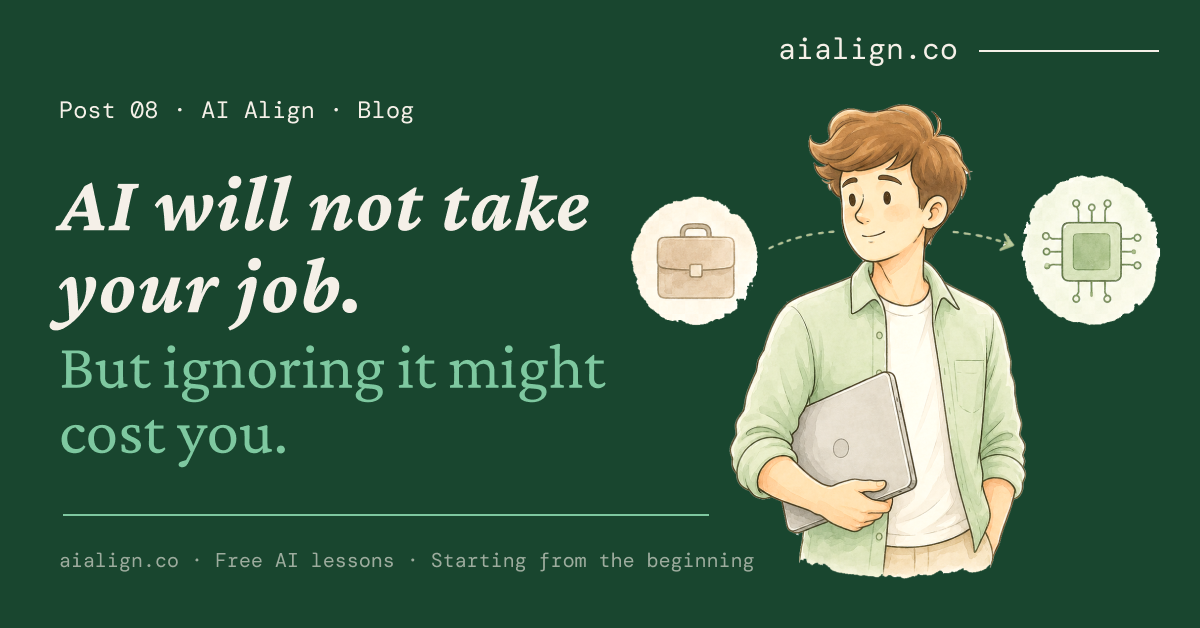
AI will not take your job. But ignoring it might cost you.
TL;DR: AI is not replacing people — it is changing how fast people can work. The person who uses AI alongside their existing skills will always move faster than the person who refuses to look at it. You do not need to become an AI expert. You need to use AI for the things you are already good at. This is not about fear. It is about staying relevant.
The fear everyone has but nobody talks about honestly.
“Will AI take my job?” It is the most Googled question about AI in India. And the honest answer is more nuanced than most people want to hear.
AI is not going to walk into your office and replace you. That is not how this works. AI cannot run a meeting. It cannot handle a difficult client. It cannot make the judgment call that comes from 10 years of experience in your industry. It does not understand office politics, cultural context, or the difference between what a customer says and what they actually mean.
But here is what AI can do: it can help the person sitting next to you draft emails in half the time, research a topic in minutes instead of hours, summarise a 50-page document in 30 seconds, and prepare for a meeting with better context than they have ever had before.
If that person is using AI and you are not — you are not losing to a machine. You are losing to a colleague who works with one.
What this actually looks like in India right now.
Your manager is already using AI to draft updates and summaries. Your CA is using it to pull together tax research faster. The teacher at your child’s school is using it to create question papers. The recruiter reviewing your resume might be using AI to screen applications before a human ever reads them. Your doctor is reading AI-generated summaries of the latest research on your condition.
None of them are doing anything wrong. They are using a tool that helps them do their existing job better and faster. Most of them have not told anyone — because using AI still feels like something you are supposed to keep quiet about, like it is an unfair advantage.
It is not unfair. It is just new. And like every tool before it — calculators, email, Google, smartphones — it will stop feeling new within a year or two. The people who started early will just be further ahead.
You do not need to become an AI expert.
This is the part that matters most. The fear of AI is often really the fear of having to learn something massive, complicated, and technical. But that is not what is being asked of you.
You do not need a course. You do not need a certification. You do not need to understand how neural networks work or what a large language model is under the hood.
You need to take the skills you already have — your industry knowledge, your judgment, your experience, your relationships — and learn to use AI as a tool alongside them. That is it.
A CA who uses AI to draft client summaries faster is still a CA. A teacher who uses AI to create practice questions in minutes is still a teacher. A business owner who uses AI to reply to 20 customer messages in the time it used to take for 5 is still running their business — just with less time spent on repetitive tasks.
The skill set does not change. The speed does.
Join AiAlign WhatsApp Channel
What actually gets replaced.
AI does not replace people. It replaces tasks. Specifically, it replaces the repetitive, time-consuming parts of work that most people do not enjoy doing anyway — formatting reports, writing the same emails, summarising long documents, researching background information, creating first drafts.
What it does not replace: the decision about what to write, the judgment about whether the research is relevant, the relationship that makes a client trust you, the instinct that tells you something is off in a deal, the empathy that helps a student who is struggling.
The tasks change. The human parts stay.
The real risk is not AI. It is standing still.
Five years ago, nobody expected a shopkeeper in a Tier 2 city to have a UPI QR code on their counter. Today, the one who does not has already lost customers to the one who does. Not because UPI is complicated — but because the customers moved and the shopkeeper did not.
AI is the same transition happening now, but for knowledge work. The people who start using it — even imperfectly, even slowly — build a compounding advantage over those who wait.
You do not need to master AI. You need to start. One task. Five minutes. The understanding follows.
The tools will change. New ones will launch. Better ones will come along. But the willingness to learn, to adapt, to try something new before you are forced to — that is a career skill that lasts a lifetime.
AI will not take your job. But someone using AI — someone with the same skills as you but who started earlier — might move faster. And in a competitive job market, faster matters.
This is not about fear. It is about staying relevant. And that starts with trying.
New to AI? Start with our free guide — zero jargon, zero assumed knowledge.
Frequently Asked Questions.
Will AI take my job?
AI is not replacing people — it is replacing tasks. The repetitive, time-consuming parts of work (formatting, drafting, summarising) are being automated. But the human parts — judgment, relationships, empathy, decision-making — remain. The risk is not AI itself but falling behind colleagues who use AI to work faster.
Do I need to learn AI to keep my job?
You do not need to become an AI expert. You need to learn how to use AI as a tool alongside the skills you already have. A CA using AI for faster research is still a CA. A teacher using AI for question papers is still a teacher. The skill set stays — the speed changes.
Which jobs are most affected by AI in India?
Jobs with large amounts of repetitive knowledge work — data entry, basic content writing, report formatting, customer service scripts — are most affected. Jobs that require human judgment, creativity, empathy, cultural context, and relationship management are less affected. Most jobs will not disappear — they will change as AI handles the repetitive parts.
How do I start using AI at work without anyone knowing?
You do not need to hide it. AI is a tool, like Google or Excel. Start with one repetitive task — drafting emails, summarising notes, preparing meeting briefs. Use AI as a starting point, then edit and review before sharing. Most people around you are already doing this. The skill is starting, not keeping it secret.