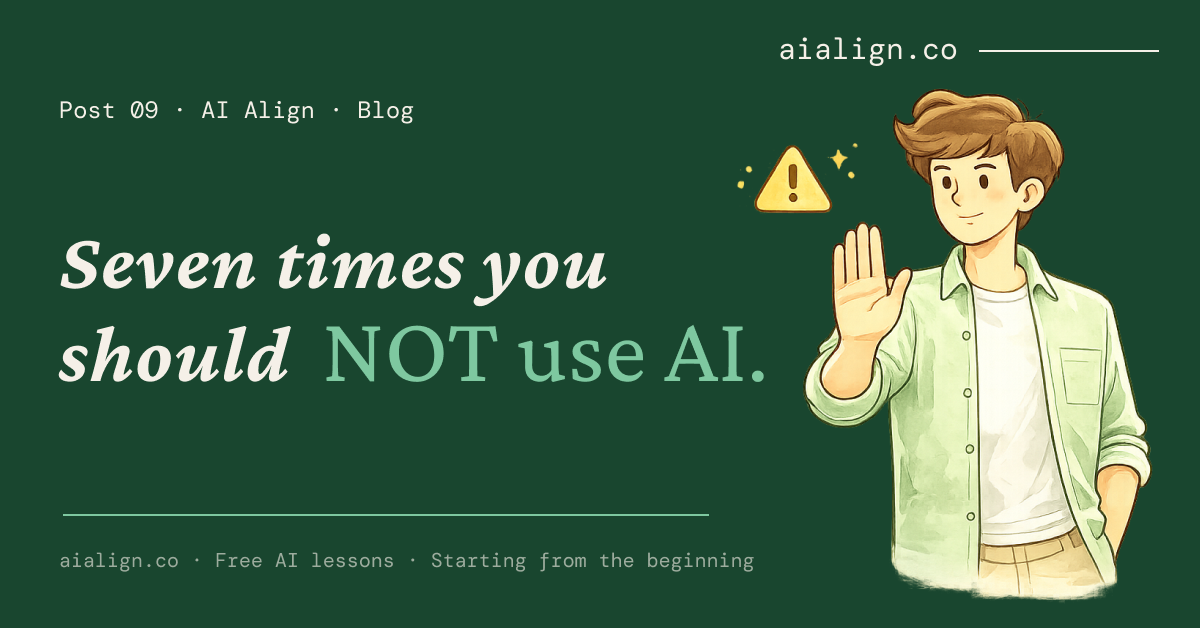
Seven times you should NOT use AI.
TL;DR: An AI education page telling you when to stop using AI. Knowing when NOT to use a tool is part of mastering it. Here are seven situations — personal judgment, sensitive data, high stakes, deep learning, empathy, factual precision, and before you have tried yourself — where the best AI skill is closing the tab.
This page exists to teach you AI. Today it is teaching you when not to use it.
That might sound like a strange thing for an AI education page to say. But it is exactly the point. A carpenter does not use a hammer for every job. A chef does not reach for a blender for every dish. Knowing which tool fits the moment — and recognising the moments when no tool fits at all — is what separates someone who uses AI well from someone who reaches for it out of habit.
Here are seven situations where the right move is to close the tab.
1. When the task requires your personal judgment.
“Should I take this job offer?” “Should I forgive this person?” “Should I move cities?” AI can list pros and cons. It can lay out a framework. What it cannot do is weigh your gut feeling, your relationship with your family, or the version of your life only you can see. These decisions carry consequences that AI will never have to live with. You do.
2. When you are dealing with sensitive personal data.
Medical reports, legal documents, financial details, Aadhaar or PAN numbers — none of these belong in a free AI tool. You do not know exactly how that conversation is stored, who might review it, or whether it gets used to train the next version of the model. If the information is sensitive enough that you would not say it out loud in a room full of strangers, it does not belong in an AI chat window either.
3. When the stakes are too high for an unchecked answer.
A legal contract. A medical dosage. A tax calculation that affects your business. AI is confident even when it is wrong — and in these situations, confidence without accuracy can cost you real money or real harm. This is where a professional — a lawyer, a doctor, a chartered accountant — earns their fee. Use AI to understand the topic. Use a professional to confirm the answer.
4. When you are trying to learn something deeply.
If a student asks AI to write their assignment and submits it as their own work, they have not learned the subject — they have outsourced the appearance of learning. The grade might look fine. The understanding will not be there when the exam, the interview, or the real job arrives. Use AI to explain a concept differently, to quiz yourself, to check your understanding. Do not use it to skip the understanding altogether.
Join AiAlign WhatsApp Channel
5. When empathy is the point.
A condolence message. A heartfelt apology. A note to someone who is going through something difficult. These moments are not about finding the most polished words — they are about the effort of finding your own words, even if they come out imperfect. A message that clearly came from AI, in a moment that called for vulnerability, often communicates the opposite of what you intended.
6. When it needs to be factually perfect.
Legal filings. Medical advice. Regulatory compliance documents. AI does not have access to verified, up-to-date facts in every domain — it predicts plausible answers based on patterns, and sometimes those answers are simply wrong, as we covered in an earlier post about AI hallucination. For anything that needs to be exactly right, professionals exist for a reason. AI can help you prepare the questions to ask them. It should not replace the answer they give you.
7. When you have not tried doing it yourself first.
This one is less about risk and more about habit. If your first instinct for every task — writing, thinking, planning — becomes “let AI do it,” you stop building the skill yourself. Use AI to improve your work after you have made a real attempt. Not to avoid making the attempt at all. The muscle you do not use eventually weakens.
The principle behind all seven.
None of these are really about AI being bad. They are about recognising what AI is for. It is extraordinary at drafting, summarising, explaining, and accelerating the boring parts of work. It is not a substitute for judgment, professional expertise, lived empathy, or the discipline of learning something the hard way.
Knowing when NOT to use a tool is part of mastering it. The person who reaches for AI for absolutely everything is not actually more advanced than the person who knows exactly when to put it down. They are simply less aware of the difference.
Screenshot this list. Refer to it before you type. The best AI skill is not knowing every prompt trick — it is knowing when to close the tab.
New to AI? Start with our free guide — zero jargon, zero assumed knowledge.
Frequently Asked Questions.
When should I not use AI?
Avoid using AI for personal judgment calls, sensitive personal data, high-stakes decisions requiring professional verification, deep learning you need to retain, empathy-driven messages, factually critical documents, and before you have made your own first attempt at a task.
Is it bad to use AI for assignments?
Using AI to write an assignment and submitting it as your own work means you have not learned the material — only outsourced the appearance of learning. It is better to use AI to explain concepts, create practice questions, or check your understanding after you have made your own attempt.
Can I share personal information with AI tools?
No. Avoid sharing passwords, Aadhaar or PAN numbers, bank details, medical records, or other sensitive personal data with AI tools. If you would not say it out loud in a room full of strangers, it should not go into an AI chat window.
Should I use AI for legal or medical advice?
AI can help you understand a topic or prepare questions, but it should not replace a qualified professional for legal contracts, medical dosages, or tax calculations. AI sometimes generates confident but incorrect information, so anything with serious consequences should be verified by a professional.