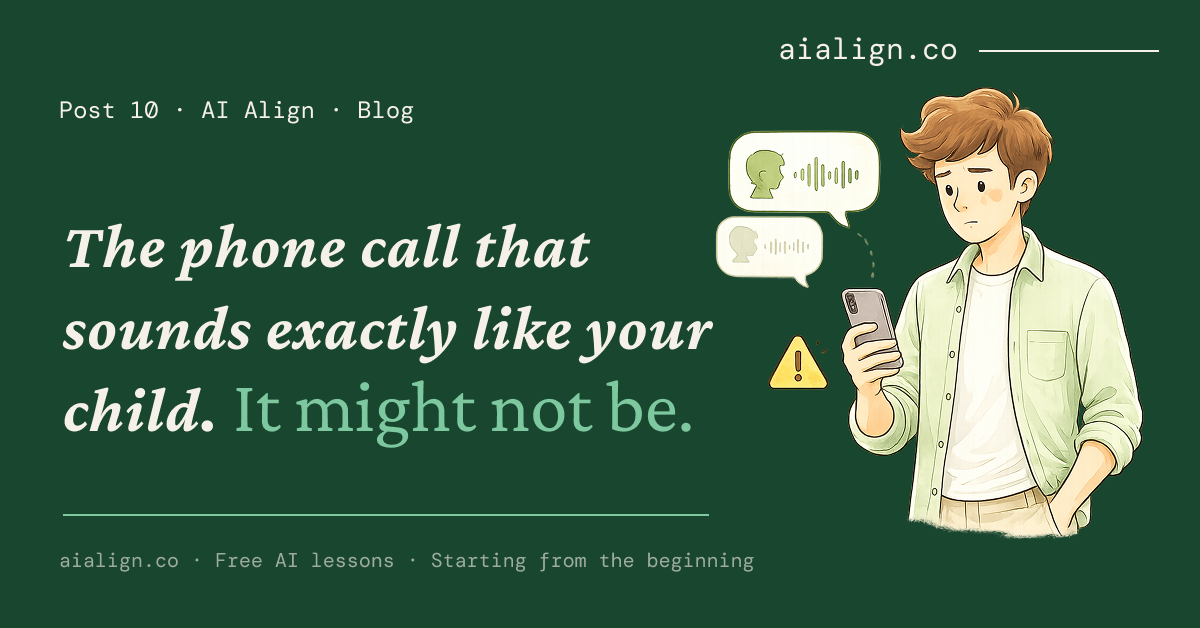
The phone call that sounds exactly like your child. It might not be.
A call you were never prepared for.
An unknown number calls. The voice on the other end sounds exactly like your son, your daughter, your grandchild. They sound panicked. There has been an accident, or they are stuck somewhere, or they have been detained — and they need money transferred right now, before they can explain properly.
Every instinct in you responds to that voice. That is the entire point. It is not really them. It is an AI-generated copy of their voice, built from a few seconds of audio that was almost certainly public — a video on Instagram, a voice note shared in a group, a reel where they spoke for even ten seconds.
This is not a hypothetical future risk. The technology to do this exists today, and the cost of doing it has dropped close to zero.
How the scam actually works.
It starts with a small amount of audio of the target’s voice — usually pulled from something already posted online. AI voice cloning tools can then generate new speech in that voice, saying anything the scammer types.
The scammer calls a parent, a spouse, or a sibling, often from an unfamiliar number, and plays the cloned voice in a moment of manufactured urgency. The fear and the unfamiliarity work together: there is no time to think clearly, and the voice removes the usual doubt a stranger’s call would create.
The request is almost always the same — a money transfer, fast, before anyone has the chance to verify. That urgency is the tell. Real emergencies very rarely require an immediate, unverified bank transfer to a number nobody recognises.
The one thing that protects you — completely free.
Agree on a single word with your immediate family today. Choose something nobody outside the family would guess — not a birthday, not a pet’s name posted on social media. If anyone calls claiming an emergency and asking for money, ask for the code word before doing anything else. No code word, no transfer.
This single habit defeats the entire scam, regardless of how convincing the voice sounds. The scammer can copy a voice. They cannot guess a private word your family chose together and never mentioned online.
Two more habits worth building into your family's routine.
Never share an OTP, PIN, or password over a call or message — not to a bank, not to a “relative,” not to anyone. No legitimate emergency, government office, or financial institution will ever ask for this information by phone. If a call asks for it, the call is fraudulent. There are no exceptions to this rule.
When in doubt, hang up and call back on a number you already trust. If the call genuinely came from your child or spouse, calling them back directly will confirm it within seconds. A real emergency will still be real two minutes later. A scam call will not survive that callback.
This belongs in your family WhatsApp group too.
The same caution applies to anything forwarded in a family group — a video, a photo, a voice note claiming to be from someone. AI-generated content is becoming harder to distinguish from real content, not easier. Before forwarding something shocking or urgent to forty relatives, a quick search elsewhere can confirm whether it is genuine.
None of this requires technical knowledge. It requires one short conversation with the people closest to you, ideally before anyone needs it. A five-minute conversation today is the entire defence against a scam that depends entirely on speed and panic.
Join AiAlign WhatsApp Channel
The technology will keep improving. The defence does not need to.
Voice cloning will likely get even more convincing over the next few years. But the protection against it does not depend on staying ahead of the technology — it depends on a habit that costs nothing and takes five minutes to set up: a code word, a no-OTP rule, and a willingness to hang up and call back.
Talk to your family about this today, not after something happens. The best protection has never been the technology. It is the conversation you have before you need it.
New to AI? Start with our free guide — zero jargon, zero assumed knowledge.