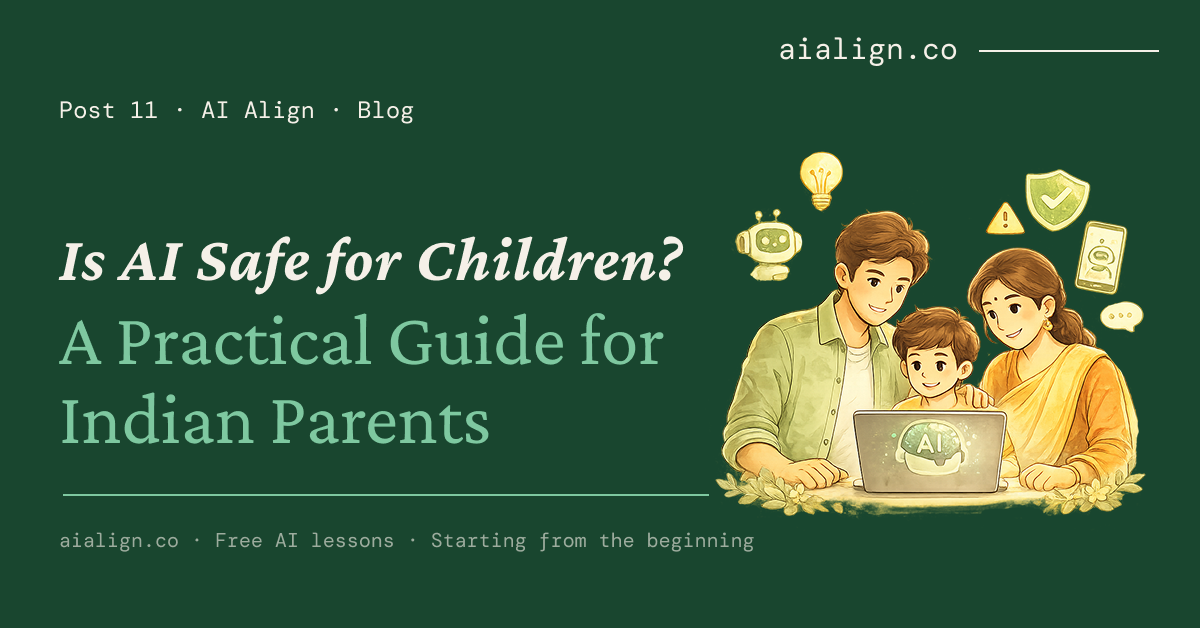
Your child is using AI. Now what?
It is already happening.
A Class 10 student in Chennai uses AI to summarise her history chapters the night before an exam. A Class 8 student in Pune uses it to generate ideas for his school project. A 16-year-old preparing for board exams asks it to explain photosynthesis three different ways until one explanation finally clicks.
None of them waited for permission. The tool is free, it is on their phone, and it answers questions without making them feel foolish for asking. Of course they are using it.
The question is not whether your child uses AI. It is what they do with it, and whether you are part of that conversation.
What is actually worth worrying about.
AI tools are not built to harm children. But three things genuinely deserve a parent’s attention.
Confident wrong answers. AI does not say “I am not sure.” It gives every answer with the same confidence — whether it is correct or invented. A child who does not know to verify will sometimes submit wrong information in an assignment, or believe something that is not true. The habit to build early is simple: anything important, check it elsewhere before you trust it.
Skipping the thinking. “Summarise this chapter” helps revision. “Write my entire essay” skips the thinking entirely. The homework looks done. The understanding was never built. This matters most around exam time, when every shortcut taken during preparation shows up as a gap in the exam hall.
Sharing personal details. Children may type their school name, their address, their daily schedule, or a personal problem into an AI tool without thinking twice. The rule is the same as with any app: do not share anything you would not say out loud to a stranger.
Age makes a difference.
A useful starting framework for Indian families:
Under 10: Use AI together, not alone. Sit beside them. Ask the question together, read the answer together, and talk about it. At this age, AI is most useful as a conversation starter — something that makes you both curious — not as a solo tool.
10 to 14: They can use it independently for school help, but a few agreed limits help. What is off-limits to type (personal details, private family matters). What they should do with anything AI tells them (verify important facts). What the difference is between AI helping them understand something and AI doing the work for them.
15 and above: Treat them like a young adult using a new tool. Teach verification and judgment — the same skills you would want them to apply to anything they read online. Discuss the cases where AI gets things wrong. Talk about what kind of work is genuinely theirs and what has been outsourced.
The one rule that covers most situations.
Make AI a normal topic of conversation at home — not a secret and not a forbidden topic.
If your child feels they can tell you “I used AI for this,” they will. If they feel it is something to hide, they will use it quietly — without your guidance, and without the chance to ask questions about what they saw or read.
Curiosity handled openly is always safer than curiosity handled secretly. This is true of the internet, of social media, and it is true of AI.
Join AiAlign WhatsApp Channel
What this does not mean.
This is not a reason to hand a 7-year-old a phone and say “use AI freely.” Younger children genuinely benefit from a parent sitting alongside them. And for any age, it is worth knowing which tools your child is using and checking the privacy settings on those tools — free AI tools often use conversations for training their models, which is another reason to avoid sharing private details.
But it also does not mean installing monitoring software, banning AI from the house, or treating curiosity about new tools as a discipline problem. Children who are taught to ask about something are far better equipped than children who are told never to touch it.
The conversation worth having this weekend.
Not a lecture. Not a set of rules read from a phone. Just a question over dinner or on the way to school: “Have you tried using AI for anything?”
That question opens the door. What they say next tells you exactly how to continue the conversation.
New to AI? Start with our free guide — zero jargon, zero assumed knowledge.